


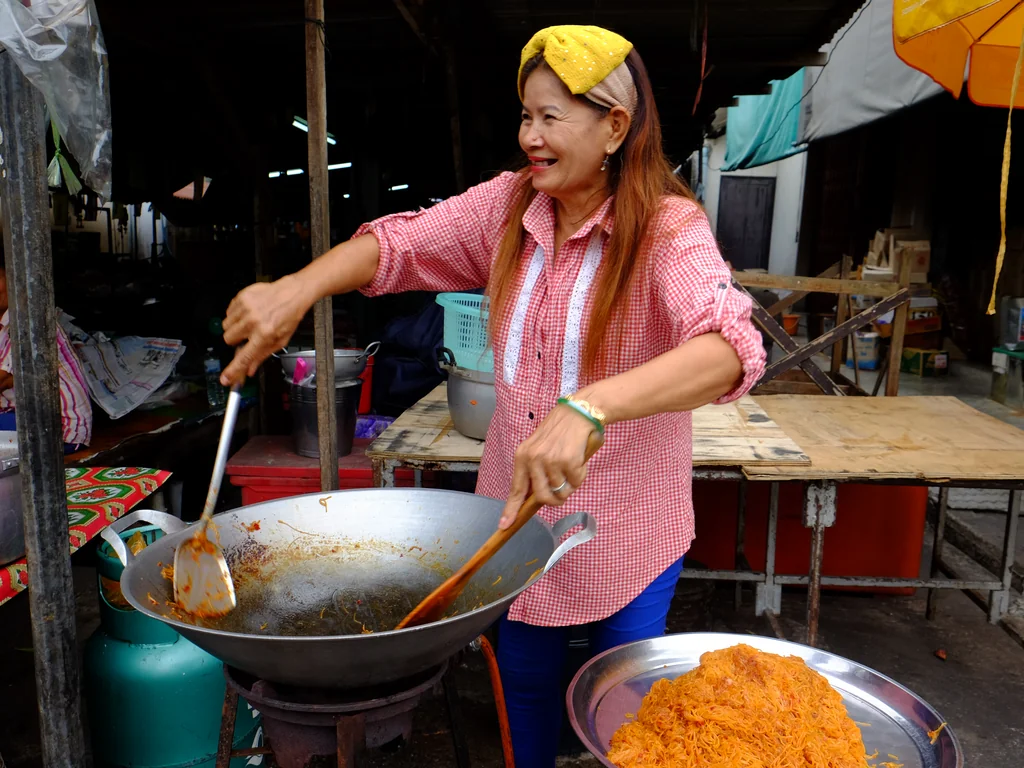
A Foodie’s Guide to Sanjao Night Market and Surat Thani Street Food
Sanjao Night Market is where a Surat Thani evening can become more than a stop between the airport, railway station and islands. Come hungry, browse the small food lane near the City Pillar Shrine, and let the dishes that are freshly prepared that night guide your order.
For a broader sense of the neighbourhood, start with this Surat Thani city travel guide. It puts the market within the old-town area and a flexible evening that can include the shrine and the Tapee River. This guide stays focused on the food: how to approach the market, what the local food culture can tell you, and how to order without treating every stall as a fixed attraction.
Sanjao Night Market or San Chao Market?
The approved title of this article uses Sanjao Night Market, a spelling many visitors will encounter while planning a trip. The Tourism Authority of Thailand uses San Chao Market (Surat Thani Night Market) for the food market in Talat Subdistrict, Mueang Surat Thani. You may also see the Thai name Talat San Chao.
The difference is useful to know when searching maps, transport apps or local information. It does not refer to a separate market. Look for San Chao Market near Surat Thani City Pillar Shrine, then confirm the current location and activity locally before you set off. Markets are working places, so individual vendors, weather arrangements and operating patterns can change.
TAT describes a small lane of carts and shops near a shrine, with local savoury dishes and sweets alongside familiar Thai market food. Rather than arriving with a long checklist, make a slow circuit first. Notice what is cooked to order, which stalls have a steady turnover and where local customers are choosing to eat.
How to eat your way around the market
Street-food markets reward a flexible approach. A stall’s best dish may be the one that is selling quickly, and it may not be available on the next visit. Start with a modest order, then add another dish once you know what appeals to you.
The official market listing mentions dishes such as pad Thai, fish cakes, fried mushrooms and rice-noodle dishes. Treat these as examples of recorded offerings, not a promise that every item will be present at every stall. A good first question is simple: point to a dish and ask what it is, whether it is spicy, and whether it can be made less spicy. A translation app can help, but a smile and a gesture usually go a long way.
If you are sharing, choose foods with contrasting textures and temperatures. A made-to-order noodle or rice dish can sit alongside a grilled snack, something fried and a local sweet. That creates an evening meal without asking one stall to represent all of Surat Thani cuisine.
A few practical habits make the experience easier:
- Carry small notes and coins, as individual stalls may not accept the same payment methods.
- Check the food in front of you before ordering, especially if you have allergies or dietary restrictions.
- Ask about chilli rather than assuming a dish will be mild. Southern Thai food can be assertive.
- Choose a clean, busy stall with food moving regularly, then eat cooked dishes while they are hot.
- Do not rely on a published opening time, price range or a particular vendor. Check on the day, particularly during rain, festivals and public holidays.
The southern flavours to look for in Surat Thani
San Chao Market is an introduction to a wider southern Thai food culture. Rice noodles, seafood, coconut, turmeric, chilli and fragrant herbs all appear in the region’s cooking, though the balance varies between households, shops and districts.
Khanom chin is one of the clearest food signposts. These thin fermented rice noodles are commonly served with curry and fresh vegetables. Around southern Thailand, the curries can range from gentler coconut-based versions to powerful fish-based sauces. If you see khanom chin on a menu or at a morning food stall, ask which curry is available and how spicy it is that day. It is a better way to choose than ordering by name alone.
Surat Thani has also been recognised for kaeng khamin tai pla boran, a traditional turmeric tai pla curry, through the Department of Cultural Promotion’s 2023 One Province, One Local Dish programme. Tai pla is a fermented fish ingredient, and the curry is not a beginner’s mild option. Its official recognition makes it an important part of the province’s culinary identity, but it does not establish that the dish will be sold at San Chao Market on any given night. If you find it, ask the vendor about the heat and ingredients before ordering.
Seafood is another strong provincial association, shaped by Surat Thani’s coastal areas and waterways. At the market, let freshness and the actual stall offering lead the decision. It would be inaccurate to promise a particular catch, oyster dish or preparation. The better expectation is an evening with choices that reflect local supply and the cook’s own repertoire.
Do not overlook sweets and snacks. The official market description includes sweet foods, and a small dessert is an easy way to end a progressive dinner. Pick what looks freshly made, ask what is inside if needed, and be open to trying something unfamiliar in a small portion.
Make the market part of an evening in the old town
Food tastes better when it is not rushed. The market sits near Surat Thani City Pillar Shrine, a place of worship with Srivijaya-style architecture. If you visit before dinner, dress and behave respectfully, observe any instructions on site, and keep photography discreet. The shrine is an active place of reverence, not just a backdrop to a food crawl.
Afterward, take time in the older streets around Talat instead of treating the market as a single stop. You may then continue towards the riverfront or Sri Tapi Bridge, where TAT notes a pedestrian route with views across the Tapee River. “Tapi” is another common transliteration, but Tapee is the spelling used here.
This is intentionally a loose itinerary. The point is not to reach each location at a prescribed time. It is to pair a meal with the city’s streets, shrine area and river rather than reducing Surat Thani to a timetable for onward transport.
Eat well without overplanning
A market meal is often one of the most approachable ways to eat locally, but it works best when expectations stay realistic. There is no guaranteed master list of stalls, no dependable universal price list and no reason to assume a dish seen online will be available when you arrive. That uncertainty is normal, not a failure of planning.
Decide what you want from the evening instead. For a full dinner, sample two or three small orders across different stalls. If it is a light meal before travel, choose one freshly cooked dish and a drink, then leave space for a sweet. If you have dietary needs, communicate them clearly and be prepared to choose a simpler dish when the ingredients are uncertain.
San Chao Market is a Surat Thani city food stop, not a summary of every cuisine in the province. A dish may be Thai, southern Thai, Chinese-Thai, Muslim Thai or shaped by a vendor’s personal cooking style. That mix is part of what makes a night market interesting. You do not need to identify every influence to enjoy the meal, though asking politely can add useful context.
A convenient food-focused stay in Surat Thani
If your itinerary includes an evening at the market and time to explore the city, choose accommodation that supports a relaxed schedule rather than a rushed transfer. At Blu Monkey Hub & Hotel Suratthani’s facilities page, you can review the current on-property services before booking. The hotel’s Monkey Desk is described as open 24 hours for assistance and local tips, which can be useful when you need to confirm transport or ask for practical guidance on the day.
Let the evening choose the menu
The most rewarding way to visit Sanjao Night Market is to arrive curious rather than determined to replicate someone else’s order. Walk the lane, look for food that is actively being prepared, ask a few direct questions and build a meal from what is genuinely available.
That approach respects both the changing nature of a street-food market and the character of Surat Thani itself. An evening near San Chao Market can be simple: a few small dishes, a local sweet, a quiet look around the old town and a slower start to the next stage of your journey.